The UC Bookstore informs me that they should be getting copies of The Last Avant-Garde by January 15th, which will be in time to start our O'Hara unit. Though we won't be able to consult the book for our unit on Ashbery, I've already got another source lined up for background info on him, so I think we should be fine. Tomorrow, we can take a tally of how many of you have already ordered (or already have) the book, and I'll pass that number along to the bookstore so they can be sure to order enough copies.
Tuesday, January 6, 2009

Monday, January 5, 2009
Update: the Last Avant-Garde
I still haven't heard back from either bookstore in regards to the availability of David Lehman's The Last Avant-Garde, but it looks as if you can read the majority of Wednesday's assigned chapters online.
- Jacket has the entire introduction available on their website: click here
- Amazon has a large chunk of the first chapter available (it cuts off in mid-sentence, but is better than nothing at all): click here
For those of you who don't have the book, I'm adding a pair of new links which will also help provide a little background information, though they're no substitute for the Lehman book:
- A Brief Guide to the New York School: click here
- The Artists and Poets of the New York School: click here
Please make sure you get your hands on a copy of the book, even if it won't come in time for Wedneday. You'll need to read the chapters on Ashbery, O'Hara and Koch when we focus on each poet.
Sunday, January 4, 2009
Wednesday, January 7th: The New York School's Origins
 For Wednesday's class, you'll want to begin your acquaintance with the poets of the New York School by reading the opening chapters of David Lehman's The Last Avant-Garde: The Making of the New York School of Poets, which will serve as our guide throughout the quarter.
Lehman's a somewhat thorny personage, who would have you believe that he was a vital member of the First Generation of poets (in reality he was a student of Kenneth Koch's in the 1960s and perhaps a minor figure between the Second and Third Generations), but his history of this influential group of poets is the very best. Ignore all the times he casually drops the fact that he was having lunch with John Ashbery, or popped into Koch's office for a cup of coffee, and you'll be fine.
To start off our discussion, I'd like you to read Lehman's introduction (pg. 1) and chapter 1, "The Pursuit of Happiness" (pg. 19). Though it's optional, I'd also encourage you to read chapter 2, "The Band of Rivals" (pg. 65) — it adds about 30 pages, but will give you an even fuller understanding of the lives of these four poets, and Lehman's prose is an easy read.
We'll spend most of the class discussing commonalities between the life stories of Ashbery, O'Hara and Koch, and their early artistic development. At the end of class, we'll spend a few minutes on a quick primer on how to do close readings of poems.
Course Description
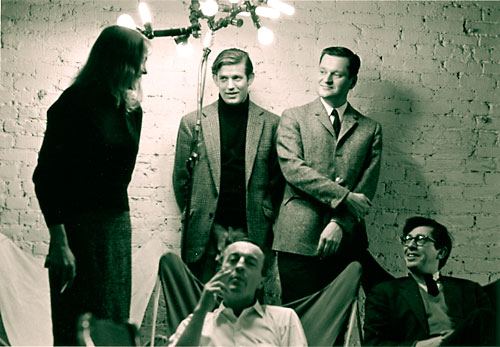
l-r: (standing) Patsy Southgate, Bill Berkson, John Ashbery; (seated) Frank O'Hara, Kenneth Koch
ENGL 202 – 003: Topics in Literature: The New York School of Poetry
We’ll study the historical development and evolution of The New York School from its 1950s core of John Ashbery, Frank O’Hara, Kenneth Koch and James Schuyler through to a second generation of 1960s poets, including Ted Berrigan, Alice Notley, Ron Padgett, Bernadette Mayer, Joe Brainard, Anne Waldman and Lewis Warsh, and on to those contemporary poets who continue to redefine New York School poetics in . Other topics discussed might include Donald Allen’s The New American Poetry: 1945-1960, The Poetry Project at St. Mark’s Church in the Bowery, the small press tradition, queer poetics, L=A=N=G=U=A=G=E poetry and the anthology wars.
ENGL 202 – 003: Topics in Literature: The New York School of Poetry
We’ll study the historical development and evolution of The New York School from its 1950s core of John Ashbery, Frank O’Hara, Kenneth Koch and James Schuyler through to a second generation of 1960s poets, including Ted Berrigan, Alice Notley, Ron Padgett, Bernadette Mayer, Joe Brainard, Anne Waldman and Lewis Warsh, and on to those contemporary poets who continue to redefine New York School poetics in . Other topics discussed might include Donald Allen’s The New American Poetry: 1945-1960, The Poetry Project at St. Mark’s Church in the Bowery, the small press tradition, queer poetics, L=A=N=G=U=A=G=E poetry and the anthology wars.
Course Requirements and Policies
Attendance/Lateness: Attendance and punctuality are mandatory. Since our work will largely consist of group discussion, missing (or arriving late for) a class can have serious and detrimental effects on your overall performance. You will automatically fail the class if you exceed five absences, though any missed classes will likely have adverse affects on your final grade. Please note that absences are absences—sick days (with or without a doctor’s note) are no different than days that you don’t feel like getting out of bed—and the only exception to this rule will be when classes are officially cancelled due to inclement weather. The attendance policy for this class will be strictly enforced. Please show respect and courtesy to your peers by arriving to each class on time.
Participation: Because so much of our work this quarter will be collaborative, participation—both in the classroom and on the course blog—is vital and necessary. Freely and comfortably sharing your insights, opinions and perspectives (as well as your questions) will be an invaluable part of our fuller understanding of the texts we’ll examine. For this reason, class participation constitutes a full 15% of the final grade. Do not underestimate the importance of this percentage: a zero can have disastrous effects upon your performance.
Course Blog: In lieu of Blackboard, I’ll be using this blog to make announcements, distribute handouts as PDFs, and share supplementary materials—including useful links, podcasts and MP3 recordings, as well as YouTube videos—which will help to broaden your class experience this semester. It’s in your best interest to check the blog one a daily basis, and to simplify that process, I’ve added links in the sidebar which will allow you subscribe to the blog’s xml feed through your preferred feed aggregator (iGoogle, Google Reader, etc.), or sign up to receive e-mail updates via FeedBurner when new posts are added.
I’d like this blog to be a useful venue for students to discuss our readings, ask questions and share links via the comments section. Please be sure to include your full name at the bottom of your message when posting a comment. Regular activity on our course blog can only help your class participation grade.
Quizzes: Over the course of the quarter, you can expect a number of short, unannounced quizzes—approximately one per week, or one per author/text—which will serve as a measure of your reading comprehension and retention. Missed quizzes cannot be made up, and will aversely affect your final grade. A hint: we’re far less likely to have a quiz if the class is having a lively and engaged conversation about the day’s readings.
Technology: In theory, technology is a wonderful thing, but in the classroom, it can be a distraction. Please make sure that your cell phone is turned off (or at the very least in silent mode) before class begins, and keep it in your bag throughout. Texting during class will not be tolerated, and if done during a quiz or exam, will be presumed to be cheating (with appropriate consequences). Finally, the use of laptops for note-taking during class is a privilege, not a right—if I believe you're using your laptop to check e-mail, surf the internet or play solitaire during class, you'll be forbidden from using it for the rest of the quarter.
Communication: Please make use of my posted office hours, the time before and after class and e-mail to discuss your performance in the course, pose questions you might have, etc. If you're having trouble, doing poorly on quizzes or just not getting the readings, it's better to ask for help sooner rather than later. Unofficially, you should meet with me at least once during the quarter.
Plagiarism: At this stage of your academic career, you are probably well-acquainted with UC’s Academic Honesty Policy and Student Code of Conduct, however after the winter break, it might be advantageous to re-orient yourself with those policies now, as you start your classes.
Plagiarism, defined as “the appropriation of information, ideas, or the language of other persons or writers and the submission of them as one's own to satisfy the requirements of a course,” can take many guises, including cheating on a quiz, cutting-and-pasting information found on the web, failing to properly cite sources or fabricating them entirely. Any student found guilty of plagiarism, in any form, will automatically fail this course. Disciplinary action will also result, including an official record of this offense, potentially affecting your academic future.
The Writing Center: The Writing Center is a valuable and free resource available to all UC students. Writing Fellows are available to help students at all stages of the writing process from brainstorming to drafting, as well as with editing essays. I strongly encourage you to have a tutor review all the writing you do for this course. Please visit their website for hours of operation, writing resources and more information.
Special Needs Statement: If you have any special needs related to your participation and performance in this course, please speak to me as soon as possible. In consultation with Disability Services, we can make reasonable provisions to ensure your ability to succeed in this class and meet its goals.
Final Grade: Your final grade will be calculated according to the following percentages:
Paper Format: All worked handed in for this class must be typed, double-spaced, and MUST be stapled. Use 12-point, Times New Roman font for each assignment, and be sure to use the MLA header. Late work will be penalized, losing a full letter grade for each class missed. If you will miss a class when an assignment is due, you can drop it off in my mailbox or at my office beforehand, or have a friend bring it to class. I will not accept work via e-mail. Any divergence from this policy will be done solely at my discretion.
Participation: Because so much of our work this quarter will be collaborative, participation—both in the classroom and on the course blog—is vital and necessary. Freely and comfortably sharing your insights, opinions and perspectives (as well as your questions) will be an invaluable part of our fuller understanding of the texts we’ll examine. For this reason, class participation constitutes a full 15% of the final grade. Do not underestimate the importance of this percentage: a zero can have disastrous effects upon your performance.
Course Blog: In lieu of Blackboard, I’ll be using this blog to make announcements, distribute handouts as PDFs, and share supplementary materials—including useful links, podcasts and MP3 recordings, as well as YouTube videos—which will help to broaden your class experience this semester. It’s in your best interest to check the blog one a daily basis, and to simplify that process, I’ve added links in the sidebar which will allow you subscribe to the blog’s xml feed through your preferred feed aggregator (iGoogle, Google Reader, etc.), or sign up to receive e-mail updates via FeedBurner when new posts are added.
I’d like this blog to be a useful venue for students to discuss our readings, ask questions and share links via the comments section. Please be sure to include your full name at the bottom of your message when posting a comment. Regular activity on our course blog can only help your class participation grade.
Quizzes: Over the course of the quarter, you can expect a number of short, unannounced quizzes—approximately one per week, or one per author/text—which will serve as a measure of your reading comprehension and retention. Missed quizzes cannot be made up, and will aversely affect your final grade. A hint: we’re far less likely to have a quiz if the class is having a lively and engaged conversation about the day’s readings.
Technology: In theory, technology is a wonderful thing, but in the classroom, it can be a distraction. Please make sure that your cell phone is turned off (or at the very least in silent mode) before class begins, and keep it in your bag throughout. Texting during class will not be tolerated, and if done during a quiz or exam, will be presumed to be cheating (with appropriate consequences). Finally, the use of laptops for note-taking during class is a privilege, not a right—if I believe you're using your laptop to check e-mail, surf the internet or play solitaire during class, you'll be forbidden from using it for the rest of the quarter.
Communication: Please make use of my posted office hours, the time before and after class and e-mail to discuss your performance in the course, pose questions you might have, etc. If you're having trouble, doing poorly on quizzes or just not getting the readings, it's better to ask for help sooner rather than later. Unofficially, you should meet with me at least once during the quarter.
Plagiarism: At this stage of your academic career, you are probably well-acquainted with UC’s Academic Honesty Policy and Student Code of Conduct, however after the winter break, it might be advantageous to re-orient yourself with those policies now, as you start your classes.
Plagiarism, defined as “the appropriation of information, ideas, or the language of other persons or writers and the submission of them as one's own to satisfy the requirements of a course,” can take many guises, including cheating on a quiz, cutting-and-pasting information found on the web, failing to properly cite sources or fabricating them entirely. Any student found guilty of plagiarism, in any form, will automatically fail this course. Disciplinary action will also result, including an official record of this offense, potentially affecting your academic future.
The Writing Center: The Writing Center is a valuable and free resource available to all UC students. Writing Fellows are available to help students at all stages of the writing process from brainstorming to drafting, as well as with editing essays. I strongly encourage you to have a tutor review all the writing you do for this course. Please visit their website for hours of operation, writing resources and more information.
Special Needs Statement: If you have any special needs related to your participation and performance in this course, please speak to me as soon as possible. In consultation with Disability Services, we can make reasonable provisions to ensure your ability to succeed in this class and meet its goals.
Final Grade: Your final grade will be calculated according to the following percentages:
- Midterm Exam: 25%
- Final Essay: 35%
- Quizzes: 25%
- Class Participation: 15%
Paper Format: All worked handed in for this class must be typed, double-spaced, and MUST be stapled. Use 12-point, Times New Roman font for each assignment, and be sure to use the MLA header. Late work will be penalized, losing a full letter grade for each class missed. If you will miss a class when an assignment is due, you can drop it off in my mailbox or at my office beforehand, or have a friend bring it to class. I will not accept work via e-mail. Any divergence from this policy will be done solely at my discretion.
Book List
The eight books you'll require for this quarter break down into three categories. This is also the order in which we'll address the authors, starting with Lehman and Ashbery, so be sure you've purchased the books in time for our discussions.
Historical Overview
Historical Overview
- David Lehman, The Last Avant-Garde: the Making of the New York School of Poets
First Generation Poets
- John Asbhery, Collected Poems 1956-1987
- Frank O’Hara, The Collected Poems of Frank O’Hara
- Kenneth Koch, The Collected Poems of Kenneth Koch
Second Generation Poets
- Ted Berrigan, The Collected Poems of Ted Berrigan
- Alice Notley, Grave of Light: New and Selected Poems 1970-2005
- Anne Waldman, Helping the Dreamer: New & Selected Poems 1966-1988
- Bernadette Mayer, A Bernadette Mayer Reader
Books have been ordered at both the UC and DuBois Bookstores. You can also find used copies from sites including Small Press Distribution, Powell's, Alibris, ABE Books and Half.com, as well as sellers on Amazon and Barnes & Noble.
Class Schedule (Subject to Change)
Given the painful brevity of the quarter, we don't have the opportunity to spend quite as much time with each poet as I'd like, and there are a number of poets I've had to leave out entirely (Barbara Guest, Ron Padgett, Joe Brainard, Lewis Warsh, Ron Silliman, any Third-Generation New York School poets), or address in one class (James Schuyler, Charles Bernstein, Hannah Weiner), however, I believe we'll still be able to get a full sense of the historical development of the New York School aesthetic, along with its evolution through a second generation of poets centered around the Poetry Project at St. Mark's Church in the Bowery, and the mid-70s innovation of Language Poetry. Though we'll move on from a given poet after a few classes, I hope you'll be able to keep their particular styles in mind in order to trace their influence from one author to the next.
Specific readings for each poet will be given in advance of their unit, and the poems themselves will be augmented with readings in Lehman's The Last Avant-Garde, recordings from PennSound and other materials.
Specific readings for each poet will be given in advance of their unit, and the poems themselves will be augmented with readings in Lehman's The Last Avant-Garde, recordings from PennSound and other materials.
Week 1
- Monday, Jan. 5: Introductions, syllabus, course outline and goals for the quarter
- Wednesday, Jan. 7: Introduction to the New York School
- Friday, Jan. 9: John Ashbery, Day 1
Week 2
- Monday, Jan. 12: John Ashbery, Day 2
- Wednesday, Jan. 14: John Ashbery, Day 3
- Friday, Jan. 16: John Ashbery, Day 4
Week 3
- Monday, Jan. 19: No Class: Martin Luther King Day
- Wednesday, Jan. 21: Frank O'Hara, Day 1
- Friday, Jan. 23: Frank O'Hara, Day 2
Week 4
- Monday, Jan. 26: Frank O'Hara, Day 3
- Wednesday, Jan. 28: Frank O'Hara, Day 4
- Friday, Jan. 30: Kenneth Koch, Day 1
Week 5
- Monday, Feb. 2: Kenneth Koch, Day 2
- Wednesday, Feb. 4: Kenneth Koch, Day 3
- Friday, Feb. 6: Kenneth Koch, Day 4
Week 6
- Monday, Feb. 9: Midterm Exam
- Wednesday, Feb. 11: James Schuyler; First Generation into Second Generation
- Friday, Feb. 13: Ted Berrigan, Day 1
Week 7
- Monday, Feb. 16: Ted Berrigan, Day 2
- Wednesday, Feb. 18: Ted Berrigan, Day 3
- Friday, Feb. 20: Ted Berrigan, Day 4 / Alice Notley, Day 1
Week 8
- Monday, Feb. 23: Alice Notley, Day 2
- Wednesday, Feb. 25: Alice Notley, Day 3
- Friday, Feb. 27: Alice Notley, Day 4
Week 9
- Monday, Mar. 2: Anne Waldman, Day 1
- Wednesday, Mar. 4: Anne Waldman, Day 2
- Friday, Mar. 6: Anne Waldman, Day 3 / Bernadette Mayer, Day 1
Week 10
- Monday, Mar. 9: Bernadette Mayer, Day 2
- Wednesday, Mar. 11: Bernadette Mayer, Day 3
- Friday, Mar. 13: New York School into Language Poetics; Charles Bernstein; Hannah Weiner
Final Paper: date, topics to be announced
Subscribe to:
Posts (Atom)

 Posts
Posts

